Governance Requirements for RTOs 2025: How to Run Effective Governance Meetings
Key takeaways
- 1Review and manage risks to students, staff, and the organisation
- 2Oversee financial viability and business continuity
- 3Track conflicts of interest
- 4Make decisions informed by data, student feedback, and compliance performance
- 5Review of the **Risk Register** and mitigation plans
Strong governance builds strong compliance
Under the Standards for RTOs 2025, governance isn't a checkbox — it's the framework that holds your compliance system together.
ASQA's Practice Guides for Leadership and Accountability and Risk Management state that governing persons must identify risks, manage resources, and make evidence-based decisions that protect students and the organisation.
Governance meetings are how you prove that leadership happens in practice. They're your main evidence of accountability, risk oversight, and continuous improvement.
Why governance meetings matter
Every RTO must demonstrate that governing persons:
- Review and manage risks to students, staff, and the organisation
- Oversee financial viability and business continuity
- Track conflicts of interest
- Make decisions informed by data, student feedback, and compliance performance
Without structured meetings, there's no clear link between leadership intent and operational action.
1. Schedule governance meetings with purpose
Set a standing meeting cycle — monthly for medium-to-large RTOs, quarterly for smaller ones.
Record these dates in your Governance Register and include them in your internal compliance calendar.
Consistency proves oversight and accountability.
2. Use a structured agenda
Your governance meeting agenda should align with Outcome Standard 4 (Governance) and the Practice Guide – Risk Management.
Include:
- Review of the Risk Register and mitigation plans
- Financial position and forecasts
- Continuous Improvement Register review
- Trainer and assessor PD updates
- Policy or procedure changes
- Student feedback analysis
- Conflicts of interest disclosures
This approach matches ASQA's expectation that governance systems are "documented, informed by data, and linked to the organisation's context and risk profile".
3. Record and follow up
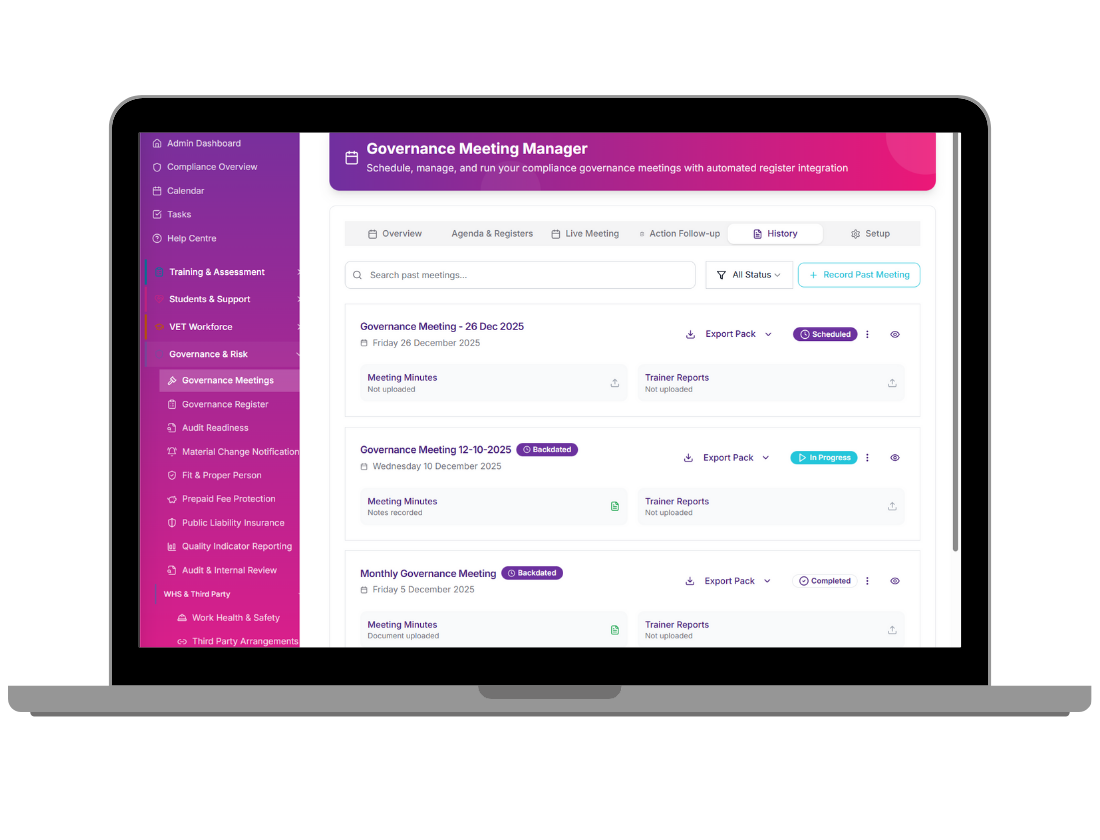
Minutes must capture decisions, responsible persons, due dates, and linked evidence.
At the next meeting, start by reviewing open actions.
Closing the loop demonstrates continuous improvement — a core principle in ASQA's governance and CI Practice Guides.
4. Link meeting outputs to registers
Each decision should flow into one of these registers:
- Risk Register – for new or changing risks
- Continuous Improvement Register – for quality actions and feedback
- Governance Register – for meeting actions and outcomes
- Assessment Validation Register – for academic quality items
Systems like ComplyHub can automate this linkage, ensuring governance evidence is traceable and audit-ready.
5. Apply ASQA's self-assurance lens
At each meeting, use ASQA's Self-Assurance Questions as prompts:
- What informs our understanding of current risks?
- How do we know our risk mitigation is effective?
- Are governing persons actively monitoring the financial position?
- How are conflicts of interest documented and managed?
This turns your governance meeting into a live self-assurance exercise — not just a compliance report.
Final thought
Governance meetings are where leadership becomes evidence.
When your RTO's governing body meets regularly, reviews data, and tracks actions, compliance becomes a culture, not a task.
The Standards for RTOs 2025 make this clear: good governance drives quality outcomes, protects students, and keeps your organisation audit-ready year-round.
Get new posts in your inbox
RTO compliance insights, governance guidance, and 2025 Standards updates — delivered directly to you.
See ComplyHub in action
Watch how RTOs use ComplyHub to manage compliance evidence, TAS documents, and audit preparation.
Related Articles

Why Every RTO Needs a Solid RTO Governance Framework — Before ASQA Comes Knocking
Standards for RTOs 2025: The Complete Transition Guide for Australian RTOs