The Governance Gap Nobody Talks About: When Policy and Practice Diverge
Key takeaways
- 1The governance gap — the difference between documented systems and operational reality — is one of the most common and costly challenges facing RTOs.
- 2Documentation alone creates a false sense of security; policies that exist on paper may not be reflected in day-to-day practice.
- 3Effective governance is not about producing more documentation — it is about creating visibility through evidence, monitoring, review, and assurance.
- 4Good governance replaces assumptions with evidence; leaders need confidence that systems are operating as intended.
- 5High-performing organisations actively verify compliance and measure quality outcomes rather than assuming they are occurring.
Most organisations have policies.
Most organisations have procedures.
Most organisations have compliance registers, meeting minutes, and documented systems.
Yet many still struggle to achieve consistent outcomes.
Why?
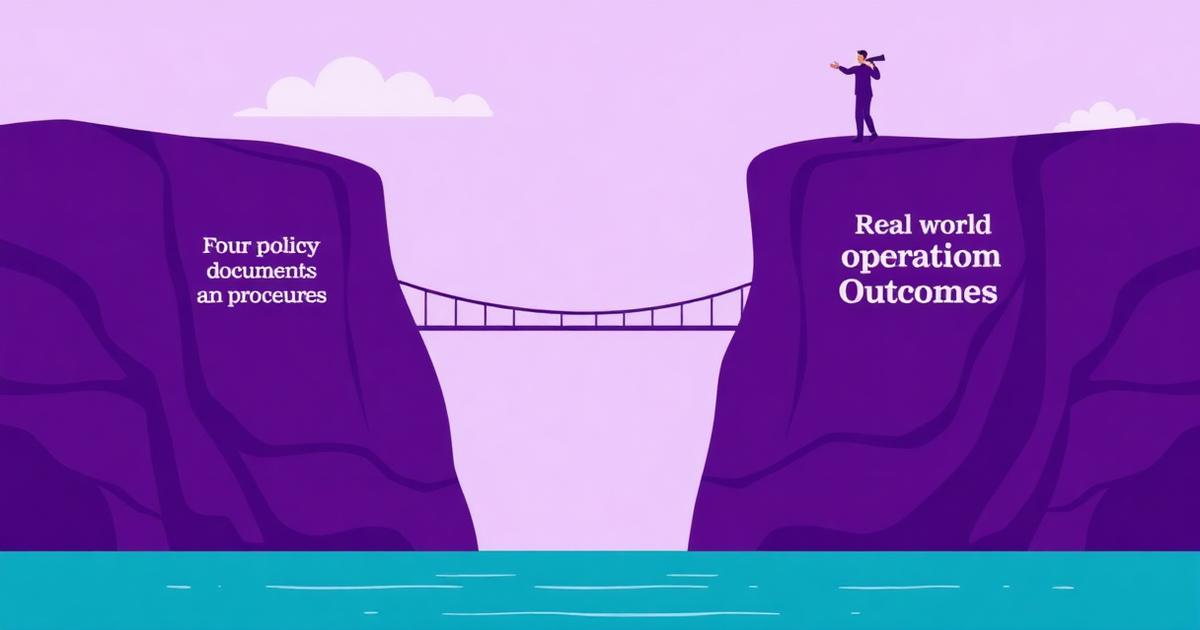
Because there is often a significant gap between what is documented and what actually happens in practice.
This is the governance gap.
It is one of the most common challenges facing organisations today, yet it is rarely discussed openly.
Table of contents
- When documentation becomes a false sense of security
- Why the governance gap matters
- Governance is about visibility
- Closing the gap
- The Governance Shift
- Want to close the gap between policy and practice?
When documentation becomes a false sense of security
Many leaders assume that because a policy exists, it is being followed.
Because a procedure has been approved, it is being implemented.
Because a system has been designed, it is operating effectively.
Unfortunately, experience tells us otherwise.
Across every sector, organisations discover during audits, reviews, investigations, and internal assessments that documented processes are not always reflected in operational reality.
The issue is rarely intentional.
People become busy.
Practices evolve.
Staff interpret requirements differently.
Workarounds emerge.
Over time, the documented system and the operational system become two very different things.
Why the governance gap matters
The governance gap creates risk.
- Leaders may believe controls are functioning when they are not
- Reports may indicate compliance while underlying practices tell a different story
- Risks can remain hidden until they become serious problems
In regulated sectors, the consequences can be significant.
- Audit findings
- Student complaints
- Workforce issues
- Financial pressures
- Reputational damage
What often surprises organisations is that these issues rarely emerge suddenly.
The warning signs were usually present long before the problem became visible.
👉 The hidden cost of reactive governance
Governance is about visibility
Effective governance is not about producing more documentation.
It is about creating visibility.
Leaders need confidence that systems are operating as intended.
That requires:
- Evidence
- Data
- Monitoring
- Review activities
- Stakeholder feedback
- Performance reporting
- Assurance mechanisms
Without visibility, leaders are forced to rely on assumptions.
Good governance replaces assumptions with evidence.
Closing the gap
Closing the governance gap requires organisations to ask difficult questions:
- How do we know our systems are working?
- What evidence supports our confidence?
- How often do we test our assumptions?
- Where could practice differ from documented expectations?
- What information are we missing?
The strongest organisations actively seek answers to these questions.
They recognise that governance is not about proving everything is perfect.
It is about understanding reality and continuously improving.
Practical steps to close the gap include:
- Regular internal audits that test operational practice against documented requirements
- Management review meetings that examine performance data, not just summary reports
- Stakeholder feedback mechanisms that identify issues before they escalate
- Continuous Improvement Register entries that link findings to verified actions
- Governance Register reviews that confirm controls are functioning as intended
👉 How ComplyHub creates visibility across governance registers
The Governance Shift
One of the key themes explored in The Governance Shift is the importance of organisational self-awareness.
High-performing organisations do not assume compliance.
They verify it.
They do not assume quality outcomes.
They measure them.
They do not assume risks are controlled.
They test their controls.
This mindset creates stronger governance, better decision-making, and greater confidence.
Because sustainable success is not built on documentation alone.
It is built on understanding what is really happening across the organisation.
Want to close the gap between policy and practice?
The Governance Shift provides practical frameworks that help leaders create visibility, strengthen assurance, and build confidence in organisational performance.
👉 Order your copy today and start bridging the governance gap.
Written by Angela Connell-Richards, CEO & Founder, Vivacity Coaching & Consulting and ComplyHub.ai
Get new posts in your inbox
RTO compliance insights, governance guidance, and 2025 Standards updates — delivered directly to you.
See ComplyHub in action
Watch how RTOs use ComplyHub to manage compliance evidence, TAS documents, and audit preparation.
Related Articles

Why Every RTO Needs a Solid RTO Governance Framework — Before ASQA Comes Knocking

Standards for RTOs 2025: The Complete Transition Guide for Australian RTOs
