The 8 Critical Drivers of RTO Success: A Framework for Sustainable Performance
Key takeaways
- 1RTO success is driven by 8 interconnected systems — weakness in one area inevitably affects performance in others.
- 2Governance and strategic leadership provide the foundation; without direction, even capable organisations lose focus.
- 3Student outcomes are not merely operational measures — they are indicators of organisational effectiveness.
- 4Financial sustainability is a governance responsibility, not simply a finance issue.
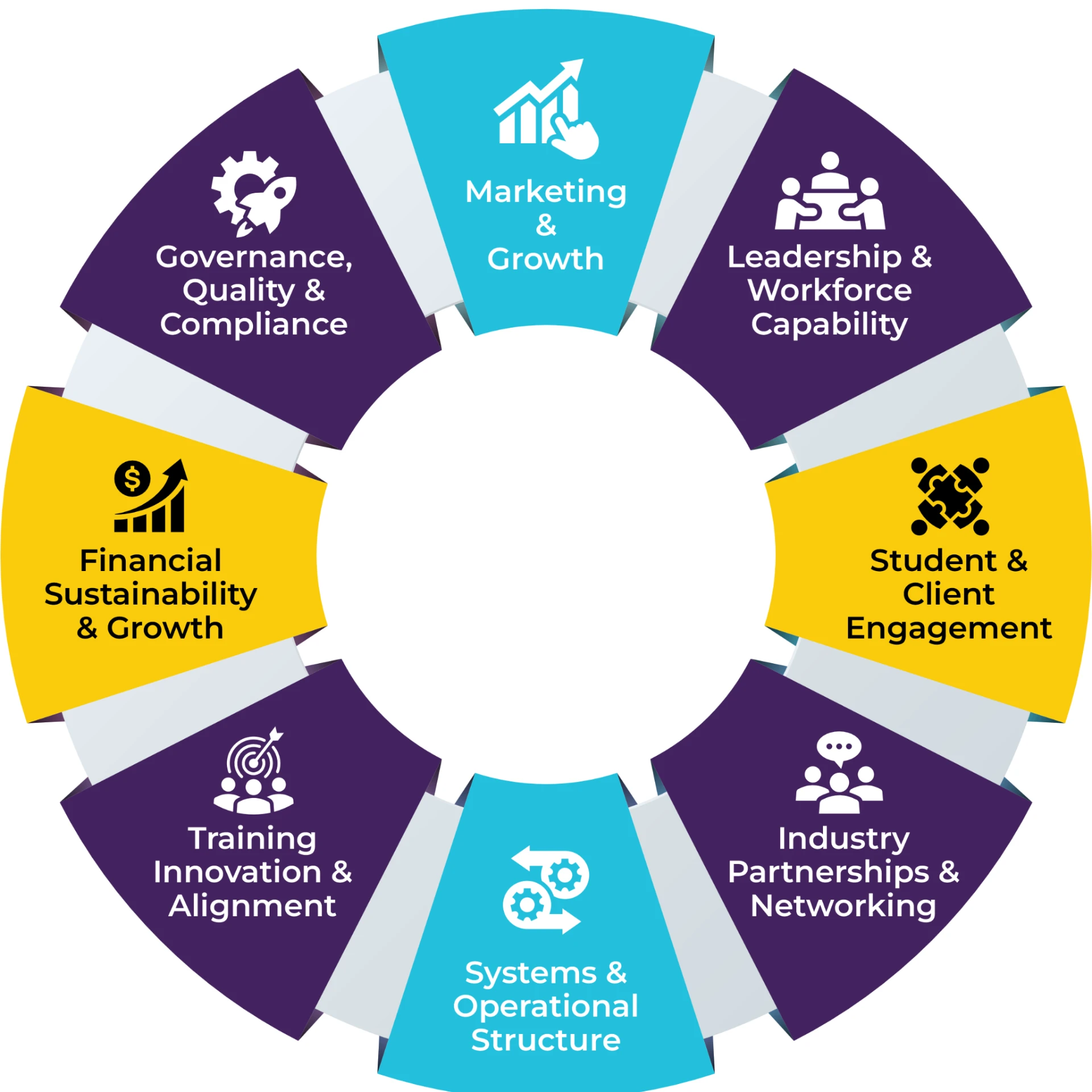
- 5The 8 Critical Drivers Framework connects every part of the organisation into a unified system for long-term success.
Why do some Registered Training Organisations consistently deliver strong outcomes, maintain regulatory confidence, attract quality staff, and grow sustainably, while others find themselves constantly responding to audit findings, workforce challenges, financial pressures, and operational issues?
The answer rarely comes down to a single factor.
Successful organisations understand that performance is the result of multiple interconnected systems working together.
Throughout the vocational education sector, many organisations focus heavily on compliance. While compliance is important, it is only one component of organisational success.
High-performing RTOs understand that governance extends far beyond policies, procedures, and audit preparation.
This concept forms the foundation of The Governance Shift, which introduces the 8 Critical Drivers of RTO Success.
Together, these drivers create the conditions for sustainable growth, quality outcomes, regulatory confidence, and organisational resilience.
Table of contents
- The 8 Critical Drivers
- Governance & Strategic Leadership
- Leadership & Workforce Capability
- Student Experience & Outcomes
- Industry Partnerships
- Systems & Operational Infrastructure
- Training Products & Delivery
- Financial Sustainability
- Risk, Assurance & Continuous Improvement
- The Real Difference: how the drivers connect
- Ready to apply the framework?
- Go deeper: The 8 Critical Drivers to RTO Success
The 8 Critical Drivers
| Driver | Core Question |
|---|---|
| Governance & Strategic Leadership | Are decisions informed by evidence and aligned with purpose? |
| Leadership & Workforce Capability | Do our people have the skills and support to deliver excellence? |
| Student Experience & Outcomes | Are learners engaged, supported, and achieving their goals? |
| Industry Partnerships | Is our training current, relevant, and aligned to workforce needs? |
| Systems & Operational Infrastructure | Do our processes and technology support consistent performance? |
| Training Products & Delivery | Is our training engaging, industry-informed, and well-assessed? |
| Financial Sustainability | Do we have the resources to maintain and improve quality? |
| Risk, Assurance & Continuous Improvement | Are we identifying risks and improving before issues emerge? |
Governance & Strategic Leadership
Everything begins with leadership.
Strong governance provides direction, oversight, accountability, and strategic focus. It ensures that decisions are informed by evidence rather than assumptions and that organisational priorities remain aligned with purpose.
Without effective governance, even capable organisations can lose direction.
Governance is not a meeting held once per quarter. It is the continuous discipline of asking whether the organisation is doing the right things, in the right way, for the right reasons.
Leadership & Workforce Capability
People deliver outcomes.
The capability of leaders, trainers, assessors, and support staff directly influences the quality of services provided to learners and industry.
Organisations that invest in workforce capability create stronger performance, better engagement, and improved student outcomes.
This includes:
- Maintaining vocational and educational competency
- Providing structured professional development
- Supporting trainers and assessors with resources and systems
- Building leadership depth across the organisation
When workforce capability is treated as a compliance requirement alone, organisations miss the opportunity to build genuine expertise and confidence.
Student Experience & Outcomes
Student success sits at the centre of vocational education.
High-performing organisations continuously monitor learner engagement, satisfaction, progression, completion, and employment outcomes.
Strong governance recognises that student outcomes are not merely operational measures. They are indicators of organisational effectiveness.
Questions that high-performing RTOs ask regularly:
- Are learners satisfied with their experience?
- Are completion rates improving?
- Are graduates finding relevant employment?
- Are support services meeting diverse learner needs?
- What do Quality Indicator results tell us?
Industry Partnerships
Industry relevance is essential.
Effective engagement with employers, industry bodies, and community stakeholders ensures training remains current, practical, and aligned to workforce needs.
Strong partnerships improve training quality and create opportunities for innovation and growth.
Governance oversight of industry engagement includes:
- Regular consultation with employers and industry advisors
- Review of training products against current industry standards
- Monitoring of graduate employment outcomes
- Participation in industry forums and advisory committees
Training that drifts from industry need loses both credibility and enrolments.
Systems & Operational Infrastructure
Great people need great systems.
Processes, technology platforms, reporting systems, and governance frameworks provide the infrastructure required to support consistent performance.
When systems are weak, organisations become dependent on individuals rather than sustainable processes.
Key systems for RTO success include:
- Student management and reporting systems
- Governance register and evidence management platforms
- Assessment validation tracking
- Complaints and appeals handling workflows
- Financial management and forecasting tools
👉 How ComplyHub automates RTO governance and evidence management
Training Products & Delivery
The quality of training delivery remains one of the most visible measures of organisational performance.
Training products must be relevant, engaging, industry-informed, and supported by effective assessment practices.
Excellence in delivery strengthens student outcomes, employer confidence, and regulatory trust.
This driver covers:
- Training and Assessment Strategies that reflect current industry practice
- Assessment tools that are valid, reliable, and fair
- Delivery methods that engage diverse learners
- Regular review and improvement of training materials
Financial Sustainability
Quality outcomes require financial stability.
Sustainable organisations understand their financial position, manage risks effectively, invest strategically, and maintain the resources necessary to support future growth.
Financial sustainability is not simply a finance issue. It is a governance responsibility.
Governing Persons should receive regular, meaningful financial reports that address:
- Revenue trends and funding compliance
- Cost structures and unit economics
- Cash flow and working capital
- Investment in systems, workforce, and quality improvement
- Risks to ongoing financial viability
👉 Learn more about sustainable RTO governance
Risk, Assurance & Continuous Improvement
Successful organisations do not wait for problems to emerge.
They actively identify risks, monitor performance, gather evidence, evaluate outcomes, and implement improvements before issues escalate.
This creates confidence among regulators, students, staff, and industry stakeholders.
Elements of a mature risk and improvement system:
- Risk Register maintained and reviewed by governance
- Internal audit schedule covering all compliance domains
- Continuous Improvement Register with documented actions and outcomes
- Regular management review of performance data
- Use of Quality Indicators and stakeholder feedback to inform priorities
The Real Difference: how the drivers connect
Many organisations focus on one or two of these drivers.
High-performing organisations actively manage all eight.
They recognise that weaknesses in one area inevitably affect performance in others.
Strong governance supports workforce capability.
Workforce capability improves student outcomes.
Student outcomes strengthen industry confidence.
Industry confidence supports financial sustainability.
Financial sustainability enables continuous improvement.
Everything is connected.
That is the essence of The Governance Shift.
Governance is not a compliance activity.
It is the system that connects every part of the organisation and creates the conditions for long-term success.
Ready to apply the framework?
The Governance Shift introduces the complete 8 Critical Drivers Framework and provides practical strategies for building stronger organisations, improving outcomes, and creating sustainable success in a changing regulatory environment.
👉 Order your copy of The Governance Shift today and start your governance transformation.
Go deeper: The 8 Critical Drivers to RTO Success
This article outlines the framework. The book sets out each driver in full, with the diagnostic questions and worksheets senior RTO leaders use to see where governance is holding and where it is fragile. Book Two in The RTO Governance Series. $29.95 plus postage.
Written by Angela Connell-Richards, CEO & Founder, Vivacity Coaching & Consulting and ComplyHub.ai
Get new posts in your inbox
RTO compliance insights, governance guidance, and 2025 Standards updates — delivered directly to you.
See ComplyHub in action
Watch how RTOs use ComplyHub to manage compliance evidence, TAS documents, and audit preparation.
Related Articles

Why Every RTO Needs a Solid RTO Governance Framework — Before ASQA Comes Knocking

Standards for RTOs 2025: The Complete Transition Guide for Australian RTOs
